


Planning is important, but the most important part of every plan is to plan on the plan not going according to plan. – Morgan Housel
On Monday, Bloomberg News published the article, “BofA Warns It’s Time to ‘Take Profits’ as Red Flags Multiply.” The article opens:
Investors should exercise caution regarding US stocks as an increasing number of “bear market signposts” point to an approaching top, according to Bank of America Securities.
There are “too many red flags,” strategists led by Savita Subramanian wrote in a note dated June 5. “Take profits,” they advise.
This sounds scary until you get to the last paragraph, which reads:
“We see opportunity in S&P 500 stocks, but not the overall cap-weighted index,” Subramanian said. Her year-end S&P 500 year-end target is 7,100; the index closed 0.3% higher at roughly 7,406 on Monday. [emphasis added]
In other words, she thinks the S&P 500 will fall roughly 4% from the current levels. As a long-term investor, I do not see this as a reason to sell.
Losses Happen
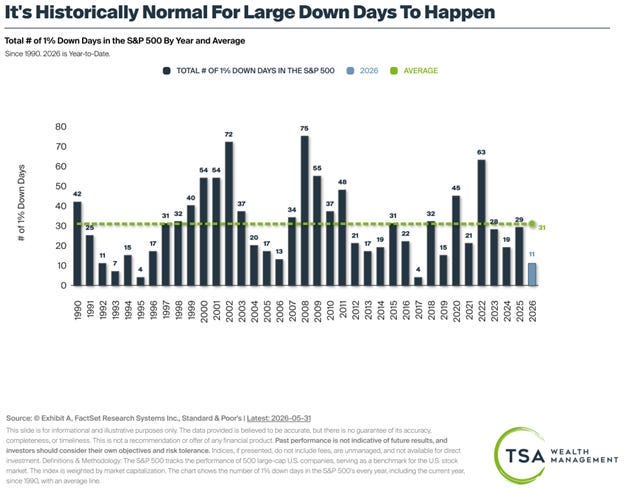
When we hosted our seminar on stock market volatility last week, I used the chart below to make the point that one-day pullbacks of at least 1% are completely normal
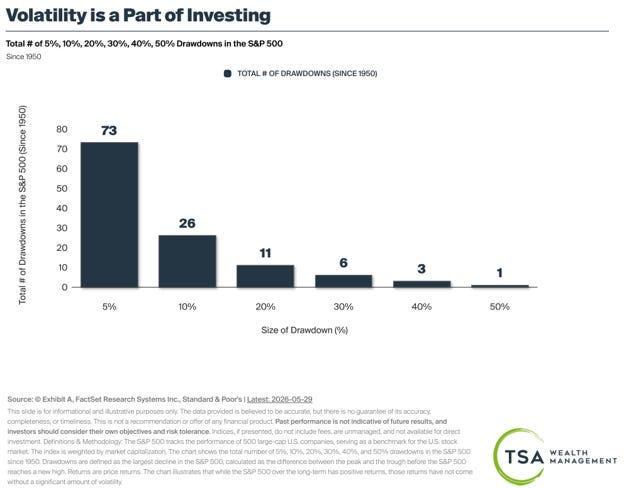
And I used this chart to make the point that 5% pullbacks occur just as frequently, with 30-50% declines not out of the question.
The chart I should have also included is this next one, which shows what would happen if you sold at every 5% pullback to avoid the risk of bigger losses and bought back in when the market returned to all-time highs.
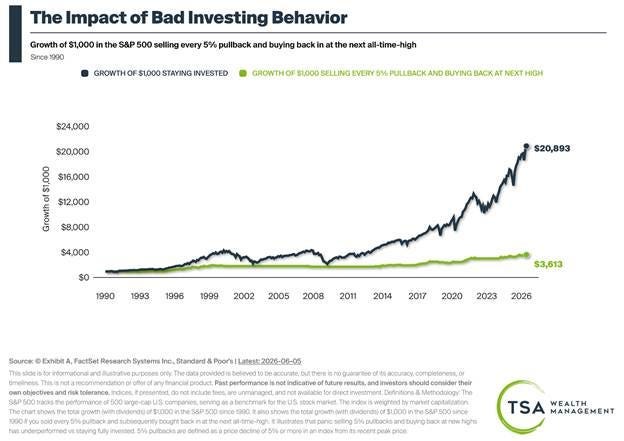
After a little over 35 years, the buy-and-hold strategy has climbed from $1,000 to over $20,000, thanks in large part to the market’s performance since 2009, while the strategy designed to limit volatility is roughly $17,000 behind, the result of a choice, repeated dozens of times, to treat normal volatility as a problem to be solved.
But What If the Market Falls 30%?
This happens. It has happened 6 times since 1950, so surely it will eventually happen again. The trick isn’t trying to time the collapse. It is having the discipline to maintain sufficient short-term reserves such that you are never forced to sell, emotionally or financially, at the worst possible time.
Because, at some point, the stock market won’t immediately rebound and the headlines will get loud enough that doing nothing will start to feel irresponsible. In those moments, the only investors who can stay on course will be those prepared to ride it out.
Personal Note:
The last two weekends, we have been at lacrosse tournaments in Dallas and Austin. One more in Plano next weekend, and our lacrosse season will officially end for a few months.
I didn’t film or edit this video, but my 70-pound son describes his goal here as “tuff.”
Thanks Jon
When it comes to writing about investments, the disclaimers are important. Past performance is not indicative of future returns, my opinions are not necessarily those of TSA Wealth Management, an SEC-registered investment advisor, and this is not intended to be personalized legal, accounting, or tax advice etc.
For additional disclaimers associated with TSA Wealth Management please visit https://tsawm.com/disclosure or find TSA Wealth Management's Form CRS at https://adviserinfo.sec.gov/firm/summary/323123