


While stocks of all shapes and sizes have experienced double-digit returns this year, bonds lost 0.69% through July. And every day bonds underperform, it becomes easier for investors to question why they should own them at all.
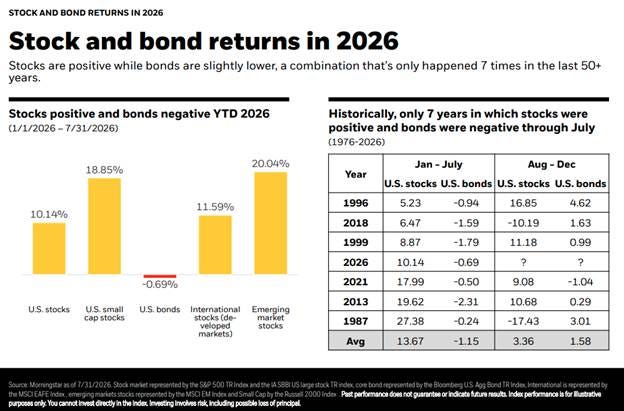
But stocks and bonds are very different tools that serve very different purposes, and sometimes you just need a reminder of why we have an allocation to bonds in the first place.
Regret Minimization
Prof. Harry Markowitz won the Nobel Prize in economics in 1990 for his pioneering work on diversification and Modern Portfolio Theory. However, when describing how he first set the asset allocation for his portfolio in the mid-1950s, he told Jason Zweig,
“I should have computed the historical covariances of the asset classes and drawn an efficient frontier. Instead, I visualized my grief if the stock market went way up and I wasn’t in it–or if it went way down and I was completely in it. My intention was to minimize my future regret. So I split my contributions fifty-fifty between bonds and equities.”
In other words, we have no idea what the future holds. The stock market may keep going up, or it could fall. Interest rates may keep rising, or they could go back to zero.
Given the inherent uncertainty about what happens next, an allocation to bonds is an effective tool for managing future regret.
Cash Flow Needs
My belief that stocks will outperform bonds over the next 30 years is nice, but completely irrelevant to an investor with near-term goals and spending needs. Owning some amount of high-quality short-term bonds is a good way to manage the risk of being forced to sell stocks when they are down.
Take Advantage of Higher Interest Rates
Bond prices have fallen because interest rates have risen. If you liked bonds during COVID when the ten-year US Treasury was near 0.5%, you should love the same bonds today now that they’ve climbed back to over 4.7%. In dollar terms, $1 million of a ten-year Treasury in 2020 generated $5,000 per year in income. Today those same bonds would generate $47,000.
But What If Interest Rates Keep Going Up?
Humans tend to over-index to whatever has recently happened. When things go down in value, people tend to think they will go down forever, and when things go up, people tend to buy thinking prices will go up forever.
But change is inevitable.
That is why diversification matters: if we do it right, at any given moment, at least one asset in the portfolio will disappoint us. If everything is going up at the same time, we may be taking more risk than we realize.
Very interesting & informative
Thanks
When it comes to writing about investments, the disclaimers are important. Past performance is not indicative of future returns, my opinions are not necessarily those of TSA Wealth Management, an SEC-registered investment advisor, and this is not intended to be personalized legal, accounting, or tax advice etc.
For additional disclaimers associated with TSA Wealth Management please visit https://tsawm.com/disclosure or find TSA Wealth Management's Form CRS at https://adviserinfo.sec.gov/firm/summary/323123