


Wall Street has a gift for complicating investments in ways that allow them to make more money. Structured notes are a good example of that. Most investors have never heard of them, but if you have money, someone has probably tried to sell you one. Here is how that conversation with a broker tends to go.
Investor: I think I’d like to invest in gold.
Wall Street: I’ve got a great idea about how you should do that!
Investor: I’m thinking I just buy an ETF like GLD.
Wall Street: Actually, if you weren’t a sophisticated investor, that might be fine. But given your resources and your sophistication, I think a structured note called a Snowball Autocall makes more sense as a play on precious metals.
Investor: If your rich clients use it, I’d like to use it too. How does it work?
Wall Street: It’s a three-year bond issued by our bank, and the return is tied to the price of the GLD (gold) and SLV (silver) ETFs.
Investor: Okay. What makes it better than just buying the ETF?
Wall Street: If, on any quarterly observation date after 1 year, the tickers GLD and SLV are greater than or equal to their initial levels, the note is automatically called, and you will receive full principal back plus 32% per annum.
Investor: Wow. 32% per year would be a great return! What happens if they aren’t up?
Wall Street: Not that they won’t be, but if the note is never called and the worst-performing underlier is down by less than 30%, you will receive back all your principal.
Investor: That sounds amazing. What happens if one of them is down more than 30%?
Wall Street: Again, this thing will probably be called, but if the note lives until maturity, and the worst-performing underlier is down more than 30%, you will realize the full downside. BUT, if you owned the ETF, you would have the full downside anyway. You can’t lose!
Investor: Wow. That sounds great. Let’s do it.
What the investor in the hypothetical conversation above probably doesn’t realize is that:
The bond is being offered by the issuer at $1,000, but the estimated value of the underlying securities used to create this investment is roughly $915. So, he is starting 8.5% in the hole1.
This is a bond, so even if the underlying metals perform well, the return is now subject to the issuer's credit risk.
The investor really only wanted to buy gold. But by tying the return to gold and silver, the entire return dynamic has changed. Gold may be fine, but a 50% drop in silver is very possible, and in that case, the price of gold doesn’t matter.
If you want to get out early, you can sell it in the secondary market, but you will probably get your head taken off.
This is Wall Street’s version of a parlay bet (See my note from January 2025: Sports Betting & Investing). The more moving parts they add, the harder it becomes to understand, the lower your odds of winning, and the more money they make.
Wall Street is financially incentivized to keep expanding this market, so even if it doesn’t benefit consumers, I suspect it will keep expanding.
A few related items worth mentioning
These things are everywhere.
Collectively, the US market for structured products was around $150 billion last year.
Structured products come in all shapes and sizes, and despite this 2011 study titled “The Dark Side of Financial Innovation,” which showed that structured products were overpriced to the point that their expected return was slightly below zero, these investments are still pitched as a way for investors to limit downside risk and improve returns.
Banks love structured products because they can package absurd spreads into an exciting sales pitch. Lawyers love them because the salespeople usually overpromise and underdeliver.
That is how you get the below headlines, which simultaneously appeared in my inbox last month (which inspired me to write this note).
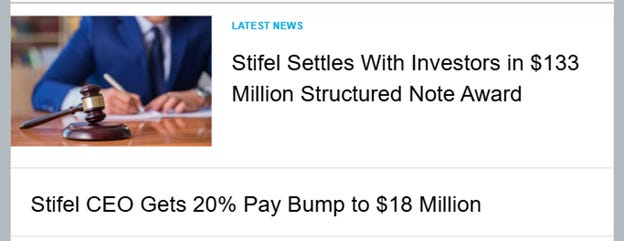
My favorite quote from the article regarding the litigation:
The plaintiffs had argued that Stifel failed to exercise “any adequate supervision” as the broker, Chuck Roberts, assured them that the structured notes would preserve their principal while offering long-term average returns of 12.25%.
I don’t care how sophisticated you are. Anytime someone promises a safe 12% return, something bad is probably about to happen.
Personal Note:
Last week I presented at my 5th grader’s career day. I gave each kid a $5 billion Zimbabwean note to explain the concept of inflation. Some kids didn’t pay attention to the discussion and left the classroom with a genuine belief they were now rich.

Each of these structured notes comes with an offering document explaining the investment. If you open it up, you will see a chart somewhere in there that looks something like this.

When it comes to writing about investments, the disclaimers are important. Past performance is not indicative of future returns, my opinions are not necessarily those of TSA Wealth Management, an SEC-registered investment advisor, and this is not intended to be personalized legal, accounting, or tax advice etc.
For additional disclaimers associated with TSA Wealth Management please visit https://tsawm.com/disclosure or find TSA Wealth Management's Form CRS at https://adviserinfo.sec.gov/firm/summary/323123
Thanks !