


“History never repeats itself. Man always does.” – Voltaire
Last week in South Korea, 1.2 million retail accounts (roughly 1 in every 30 adults in the nation) experienced a margin call, where their broker required they cover some of the trading losses they racked up with borrowed money. Roughly 360,000 of those accounts were entirely wiped out as the country’s two major tech stocks, Samsung and SK Hynix, plunged.
My favorite article to come out of the mess is probably this one from Reuters.
It starts with interviewing a 24-year-old University student who used 500% margin loans to 15x his money and then lost it all in a matter of weeks. The article ends by saying,
“Lee says he understands [the risk of leveraged investment products] but remains convinced leverage is the best route forward.
“I’ve often compared this to poker: if you go all-in every single time, you are bound to lose.
“But if you have the discipline to only deploy that capital when the mathematical odds are heavily in your favour, it is actually quite difficult to get repeatedly wiped out in a single shot.”
I love his optimism, and the idea that next time he’ll use math to gain an edge. But it completely ignores the reality that improbable things happen all the time, and you only need to be wiped out once to lose everything.
Will something like this eventually happen in the US?
Absolutely. Today in the US:
ETFs account for 27.6% of all trade volume.
40% of that ETF volume is in leveraged products.
More than 400 of 700 US leveraged ETFs in existence have been launched in the last two years
Polymarket has applied for a license to offer margin trading in prediction markets
Retail traders are deploying capital at a record pace.
9 of the 10 most active trading days observed on the Citadel platform occurred within the past two months.
In other words, the problem of degenerate gamblers using the stock market as a casino is not a South Korean problem. It is a human problem. And it seems to be getting worse.
As a species, we have yet to learn that:
Debt narrows the range of survivable outcomes.
Long-term results don’t matter if you can’t survive whatever happens in the short-term.
Maybe this time will be different, and everyone will be fine. But I wouldn’t bet on it.
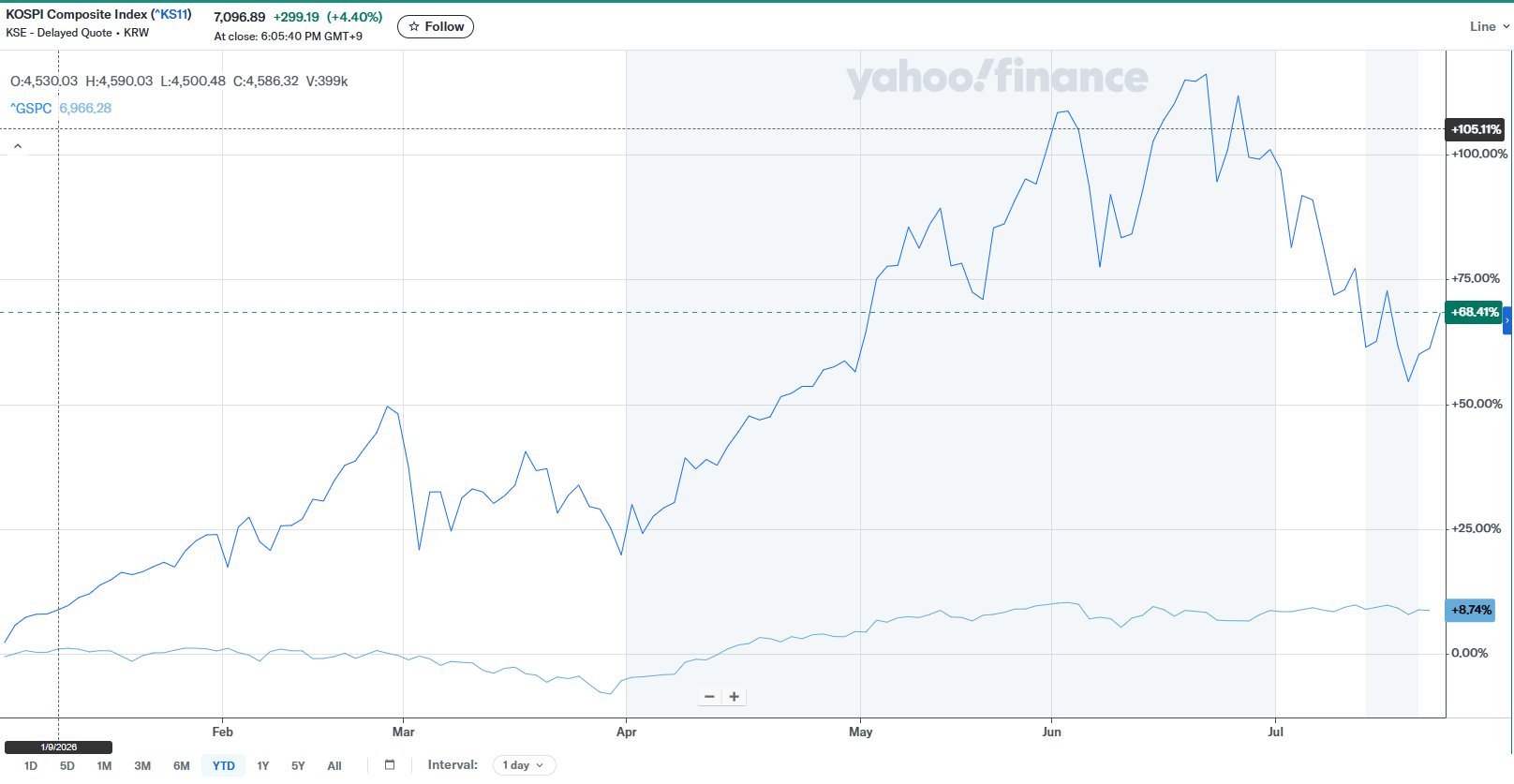
The above is not to say the US stock market is going to collapse or that now is the time to be selling. For context, here is a chart showing the Korean stock market (KOSPI) v the S&P 500 on a YTD basis as of yesterday. Leveraged investors in short-term trading vehicles lost everything. Boring investors who have bought and held are still up 68%. A far cry from the 100%+ they were up roughly a month ago, but they will live.
Personal Note:
Tomorrow we drive out to Bandera to drop the kids off at camp. We’ll see if they miss hanging out with me.

When it comes to writing about investments, the disclaimers are important. Past performance is not indicative of future returns, my opinions are not necessarily those of TSA Wealth Management, an SEC-registered investment advisor, and this is not intended to be personalized legal, accounting, or tax advice etc.
For additional disclaimers associated with TSA Wealth Management please visit https://tsawm.com/disclosure or find TSA Wealth Management's Form CRS at https://adviserinfo.sec.gov/firm/summary/323123
Great picture ! Ice Cream Cone … or whatever…. looks Grrrrrrr Great ! YUM YUM !
P S
Thanks for your financial INSIGHT ( & back-up history knowledge ++ all that & more )