


Two weeks ago, I mentioned that tax-free municipal bonds were more attractive now than they have been in a long time (See: Tax-Free Munis: A Great Deal for Some, Not Right for Others.
But what I forgot to mention then is that, in today’s market, not every tax-free muni bond is actually tax-free.
The De Minimis Tax on Discounted Munis
If you buy a tax-free muni bond at a market discount less than 0.25% for each full year from the time of purchase to maturity, it isn’t a problem.
For example, buy a 10-year bond at 97.5 (100 – [0.25 × 10 years]), and you are good to go. Everything about the purchase is tax-free.
However, once you exceed that discount, all the gain becomes taxable at ordinary income rates. For example, if you bought this same bond above for 97, you would have to pay ordinary income tax on the eventual 3% gain.
Today, because rates have risen so much, many long-term bonds issued a few years ago at 100 now trade at 60 or 70 cents on the dollar. So, to compare bonds, you can’t just look at the listed yield.
I had Claude create this chart using two hypothetical tax-free muni bonds as an example:
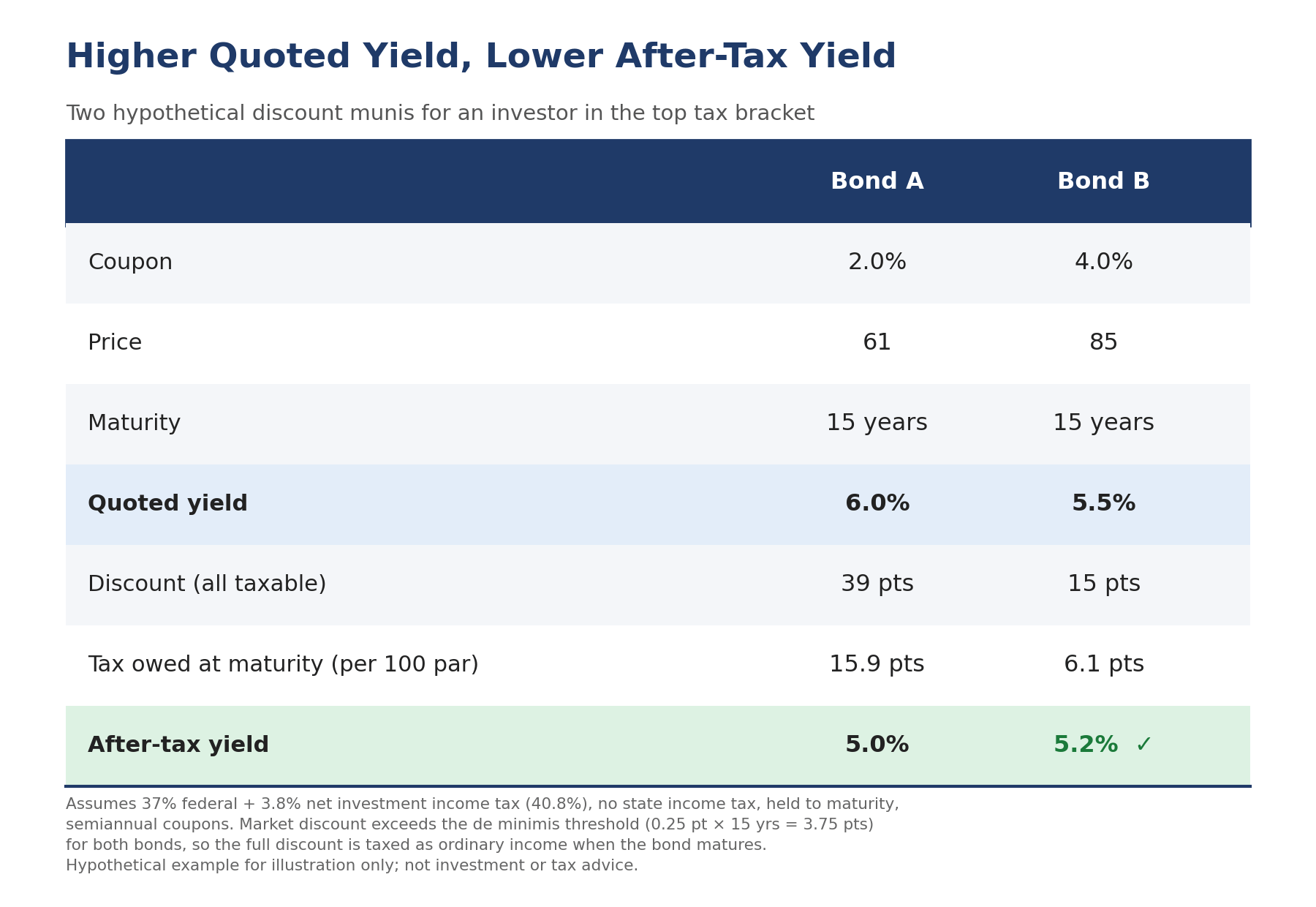
Bond A is a 15-year bond with a 2% coupon, a price of 61, and a quoted yield of 6%. Bond B is a 15-year bond with a 4% coupon, a price of 85, and a quoted yield of 5.5%.
If you were investing based solely on the highest quoted yield, you would choose Bond A.
However, because of the de minimis tax, Bond A will create a tax bill on the 39 points of gain. Bond B will only create a tax bill on the 15 points of gain.
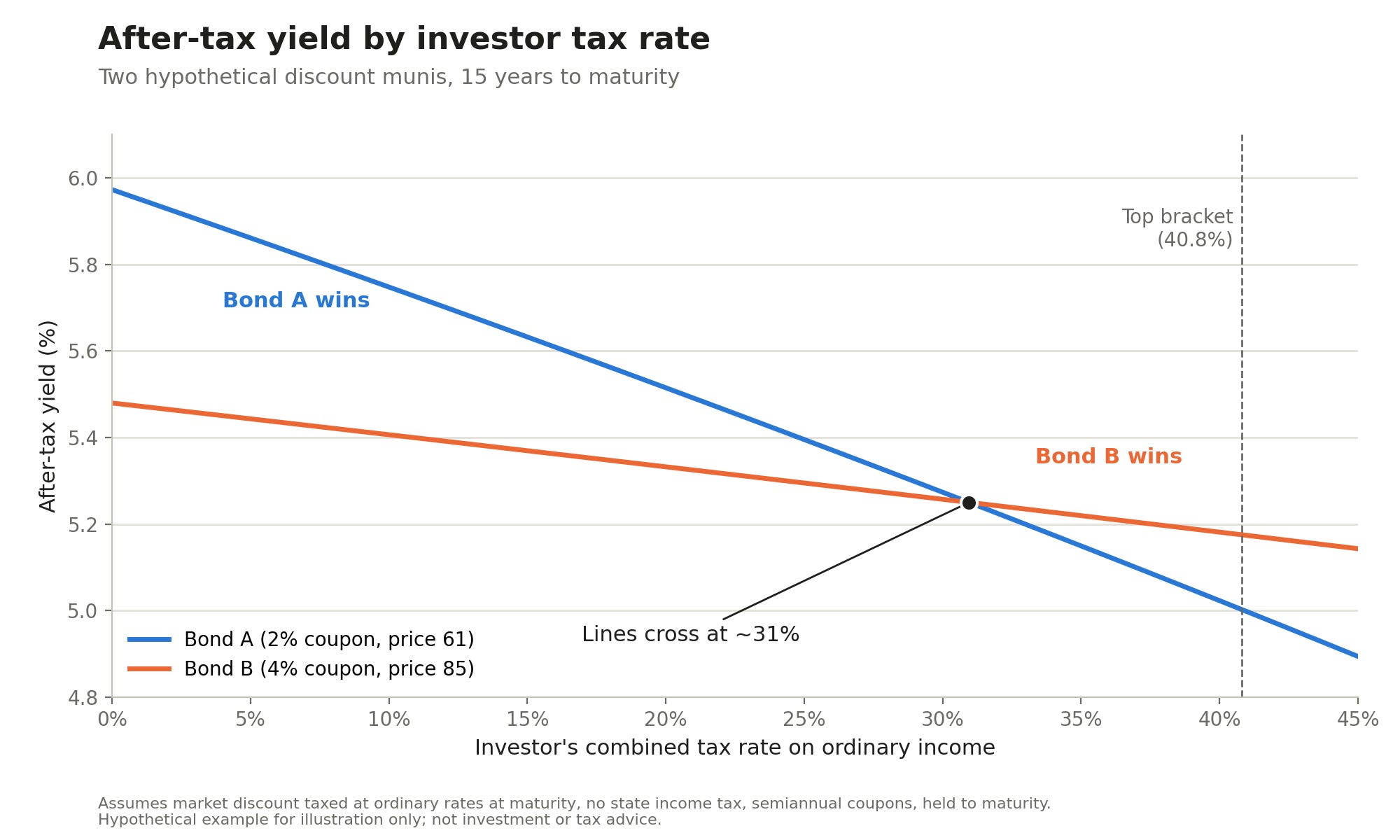
The chart above shows how this adjustment impacts the investment decision based on the investors’ tax rate. Bond B has a higher after-tax yield for the buyer in the highest federal tax bracket and is likely the better investment, all else equal.
Investors in a tax bracket below 31% are better off with Bond A.
The After-Tax Return Is the Only Number That Matters
This note is probably so far in the technical weeds that it is only interesting to me, but if you are still reading, use it as a reminder that, when it comes to tax planning and your investments, all the details matter.
Other Muni Taxes
Even when all the income on a muni portfolio is tax-free, the amount received gets added back to your income for calculating the tax on your Social Security benefits and setting your Medicare premiums. So if you're trying to use muni income to manage either number, just know it won’t work.
Personal note:
Today my daughter turns 9. Her party was last weekend at an arcade consisting entirely of claw machines.

She is the best.
This week's newsletter was a little hard to follow although the charts helped. It got me Googling more information on Munis. Thanks .