



Before my grandfather died in the early 1980s, he told my grandmother to invest 100% of their savings in short-term CDs, and she could live off the cash flow for the rest of her life. At the time, interest rates were double digits, the stock market was terrible, and the strategy seemed sound.
So that is what she did.
Year after year, she rolled her cash from one CD into the next, but as rates fell, so did her income. She never ran out of money. The strategy worked. But when my grandmother died in 2012, interest rates had fallen to zero and so had her income.
My grandfather’s strategy was built to protect against the risks he knew best.
Default risk - He had seen enough corporations go bankrupt to realize their bonds weren’t safe. FDIC insurance was a must-have.
Stock market risk - He was born before the Great Depression and had recently experienced the decade of the 70s, when large-cap stocks had real returns of roughly -1.4% / year. He fully appreciated the risks inherent in equities and saw no reason for my grandmother to deal with them.
Inflation risk - In 1970, inflation was roughly 6%. By 1974, it had climbed to 12%, and by the early 1980s, it was nearly 20%. He’d seen enough to know that long-term bonds were dangerous. By staying short-term, he was betting her income would keep pace with inflation.
It was a good plan, but I don’t think he could have imagined a world where interest rates fell to zero.1
I mention this because we’ll all face similarly tough choices.2 For example, this chart shows that today’s 10-year Treasury is more attractive in real terms than it has been in twenty years.
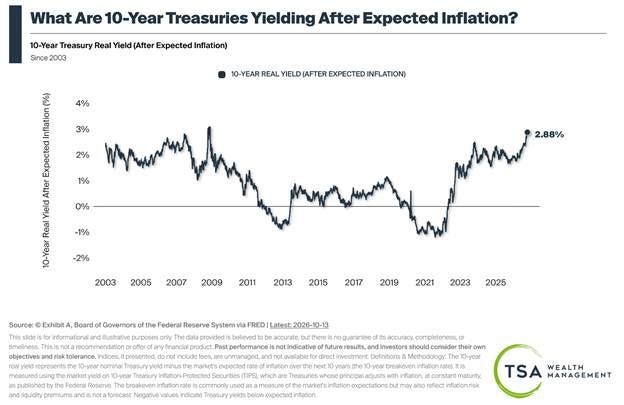
Some investors will look at this and decide the stock market has done well for them and that they don't need to do anything differently. Others will see this as an opportunity to lock in a fixed income for the rest of their lives.
There is no single right answer, and what is right for one person may be completely wrong for another. Retirement planning is mostly about figuring out which risks you are willing to take.
My grandfather got the risks he knew about right. What he couldn’t do was plan for the one he’d never seen. None of us can either, which is why the goal isn’t a perfect plan, but one that can bend when the world surprises us.
Personal Note:
My kids had the week off school for fall break. We used the opportunity to fly to Florida and throw my mom a surprise 80th birthday party.

It was a complete success.
Interest rates went negative in Europe. I saw it happen and still struggle to imagine it.
In 1981, the 30-year Treasury paid roughly 14%, while short-term CDs offered 17–19%. When given the choice between a shorter bond with a higher interest rate and a longer bond with a lower interest rate, almost everyone in my grandparents’ position chose the shorter option.
Very interesting, as I grew up in the early 70's & 80's & can remember the tough times.
When it comes to writing about investments, the disclaimers are important. Past performance is not indicative of future returns, my opinions are not necessarily those of TSA Wealth Management, an SEC-registered investment advisor, and this is not intended to be personalized legal, accounting, or tax advice etc.
For additional disclaimers associated with TSA Wealth Management please visit https://tsawm.com/disclosure or find TSA Wealth Management's Form CRS at https://adviserinfo.sec.gov/firm/summary/323123