


“The first rule of compounding: Never interrupt it unnecessarily.” - Charlie Munger
During my career day presentation a few weeks ago, I reminded the fifth graders that humans are terrible at properly conceptualizing compounding.
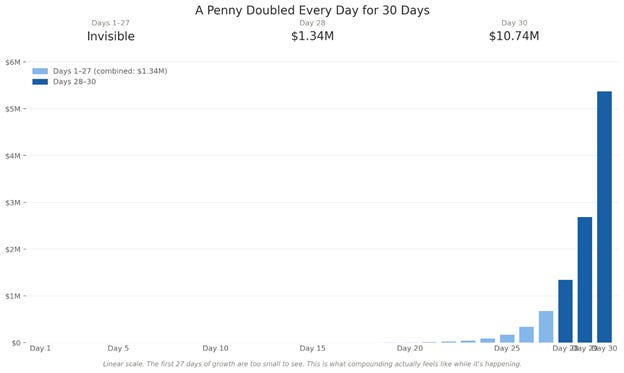
I asked the kids if they’d rather have $1,000,000 today or a penny that doubled every day for a month. Most wanted the million dollars until I showed them the math, and they learned the penny option was worth $10,737,418 after just 30 days.
I also asked them how many times they’d have to fold a piece of paper in half for it to be thick enough to reach the moon. Most of their guesses were much higher than the correct answer of 42.
And even once they knew it only took 42 folds to make the paper thick enough to reach the moon, most found it hard to believe it only took 43 folds to get all the way to the moon and back.
Investing is the same way.
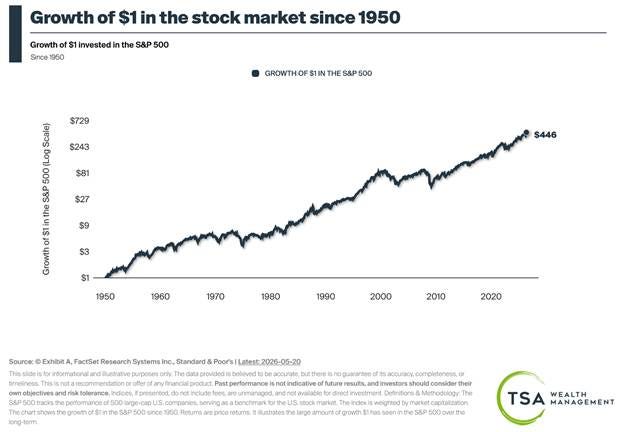
The investor who put $10,000 into the S&P 500 (a compounding investment) in 1950 and lived off the dividends now owns an asset worth roughly $4.4 million and receives an annual dividend of roughly $46,000. The investor who bought $10,000 of a hypothetical 76-year bond (a simple interest investment) with an 8% coupon still receives $800 / year and will get back the same $10,000 at maturity.
In the near term, the implications of compounding are hard to perceive. But in the long run, they make all the difference.
Other interesting math facts that are hard for people to comprehend:
You only need 23 people in a classroom before there is a 50% chance two people share a birthday.
Thailand currently has 63 million people and a birthrate of .8 (each woman has an average of .8 kids). If this birthrate continued for 200 years, Thailand’s population would decline by 97%, leaving only around 2 million people. (For an interesting read, see: The Global Fertility Crisis Is Worse Than You Probably Think)
Personal Note:
Yesterday, my wife and I had our 15-year wedding anniversary.


Time flies when you’re having fun.
Thanks !
When it comes to writing about investments, the disclaimers are important. Past performance is not indicative of future returns, my opinions are not necessarily those of TSA Wealth Management, an SEC-registered investment advisor, and this is not intended to be personalized legal, accounting, or tax advice etc.
For additional disclaimers associated with TSA Wealth Management please visit https://tsawm.com/disclosure or find TSA Wealth Management's Form CRS at https://adviserinfo.sec.gov/firm/summary/323123